
What’s Inside a Marine Mammal Bio-Logging Tag
Whale tagging technology has advanced rapidly. Modern whale tags are far more than simple tracking devices — they are compact scientific instruments that record detailed information about how whales move, what they hear, and the conditions they experience in the ocean.
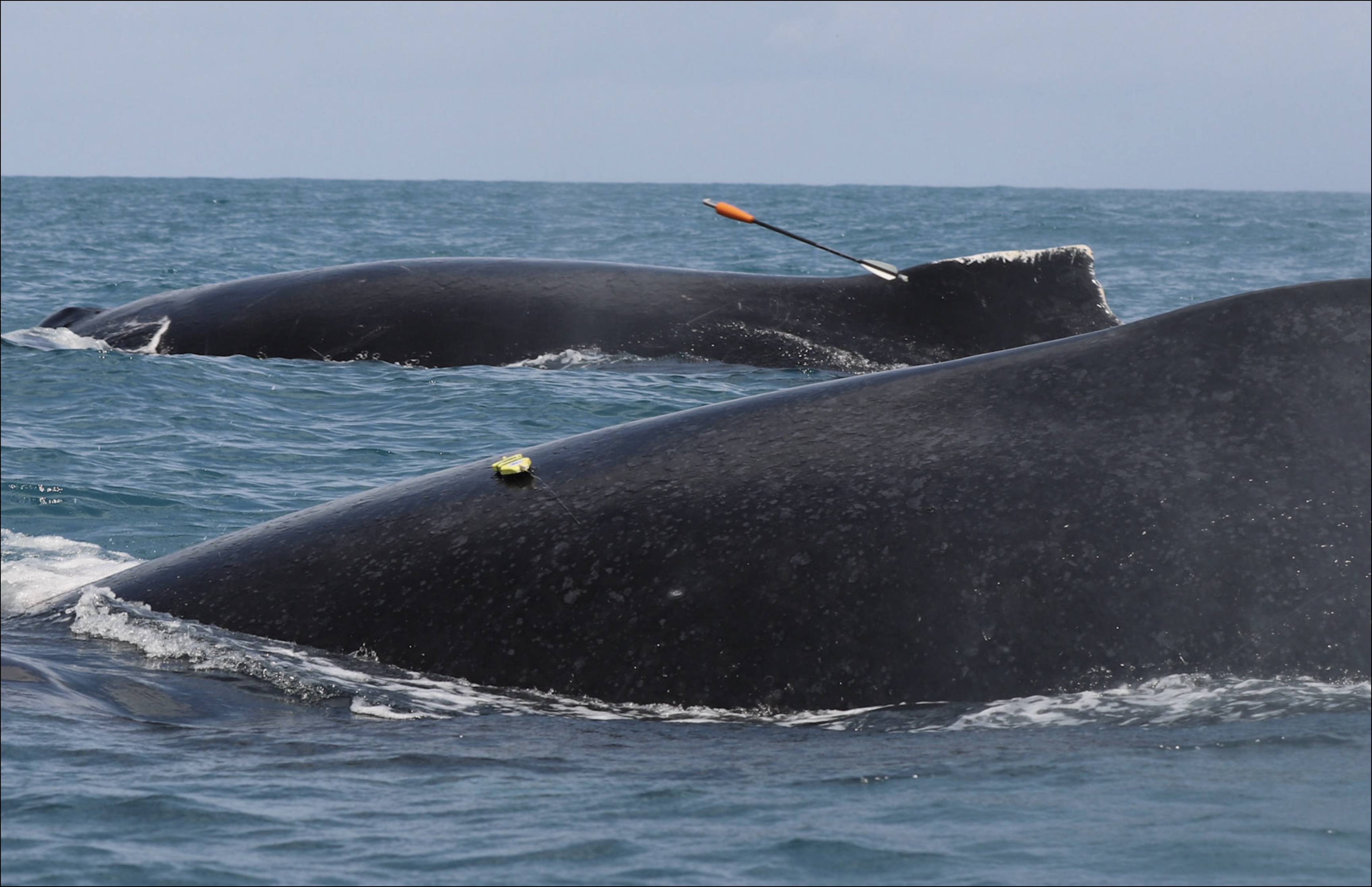
These systems are often called marine mammal bio-logging tags because they log biological and environmental data directly from the animals themselves.
At FaunaLabs, the FaunaTag platform integrates several types of sensors into a single non-invasive suction-cup tag designed for whales and dolphins. Understanding what these sensors do — and how their data streams work together — shows why whale tagging is such a powerful approach.
Movement sensors: understanding behavior
One of the most important components of modern whale tags is the inertial measurement unit (IMU).
IMUs typically contain:
- Accelerometers (acceleration in three dimensions)
- Gyroscopes (rotation)
- Magnetometers (orientation relative to Earth’s magnetic field)
Together, these sensors allow researchers to reconstruct how a whale moves underwater. From IMU data, scientists can interpret behaviors such as:
- diving and surfacing
- rolling and turning
- feeding lunges
- swimming strokes
- resting or gliding
Hydrophones: listening to the ocean
Sound plays a central role in the lives of many marine mammals. Whales communicate acoustically, and they experience the underwater acoustic environment in ways that are still being studied.
For this reason, many whale tags include hydrophones — underwater microphones.
Hydrophones can record:
- whale vocalizations
- social communication signals
- ambient ocean sound
- anthropogenic noise from ships or other activity
When acoustic recordings are combined with movement and depth data, researchers can understand not only what whales are hearing, but how they respond behaviorally.
Environmental sensors: context matters
Understanding whale behavior requires environmental context. Many marine mammal bio-logging tags include sensors that measure:
- Depth (dive profiles)
- Water temperature (habitat conditions)
These data help place behavior within the physical conditions the animal is experiencing.
Bio-optical sensors: emerging technologies
One of the most exciting developments in whale tagging technology is the adaptation of bio-optical sensing originally developed for human biomedical research.
Technologies inspired by functional near-infrared spectroscopy (fNIRS) and related optical approaches are being explored for marine mammal research. These sensors measure how light interacts with tissue and can potentially support physiology-related inference.
Adapting these technologies for whales is challenging: ocean conditions are harsh, animals move continuously, and tags must remain compact and non-invasive. But these approaches may open new possibilities for studying the physiological state of free-swimming marine mammals.
At FaunaLabs, bio-optical sensing is one area of active development within the FaunaTag platform.
Integrating multiple data streams
The real power of whale tagging technology comes from combining multiple synchronized sensor streams.
A single moment in a whale’s dive might include:
- IMU data showing body orientation and movement
- hydrophone recordings capturing the acoustic environment
- depth data showing how far the whale has descended
- temperature providing habitat context
Together, these streams provide a richer understanding than any one measurement alone. This multi-sensor approach is the foundation of marine mammal bio-logging.
Designing tags for real ocean conditions
Engineering whale tags involves unique constraints. Tags must be:
- small and hydrodynamic
- durable in saltwater environments
- capable of storing large volumes of data
- energy efficient
- safe and practical to deploy and retrieve
Balancing these constraints while improving data quality requires careful system design and field testing.
FaunaTag and the future of whale tagging
FaunaTag is designed to integrate movement sensors, acoustic recording, environmental measurements, and emerging bio-optical sensing within a single non-invasive suction-cup whale tag.
By combining these technologies, FaunaTag helps us better understand how whales behave, how they experience their environment, and how individuals respond to natural and human influences.
The better we understand whales in their natural environment, the better equipped we are to protect them.