
How Suction-Cup Tags Study Whales Without Invasive Attachment
Modern whale tagging technology has transformed how scientists study whales and dolphins in the wild. Researchers have developed increasingly sophisticated whale tags capable of recording movement, sound, and environmental conditions. Among the most important developments has been the rise of non-invasive suction-cup tagging.
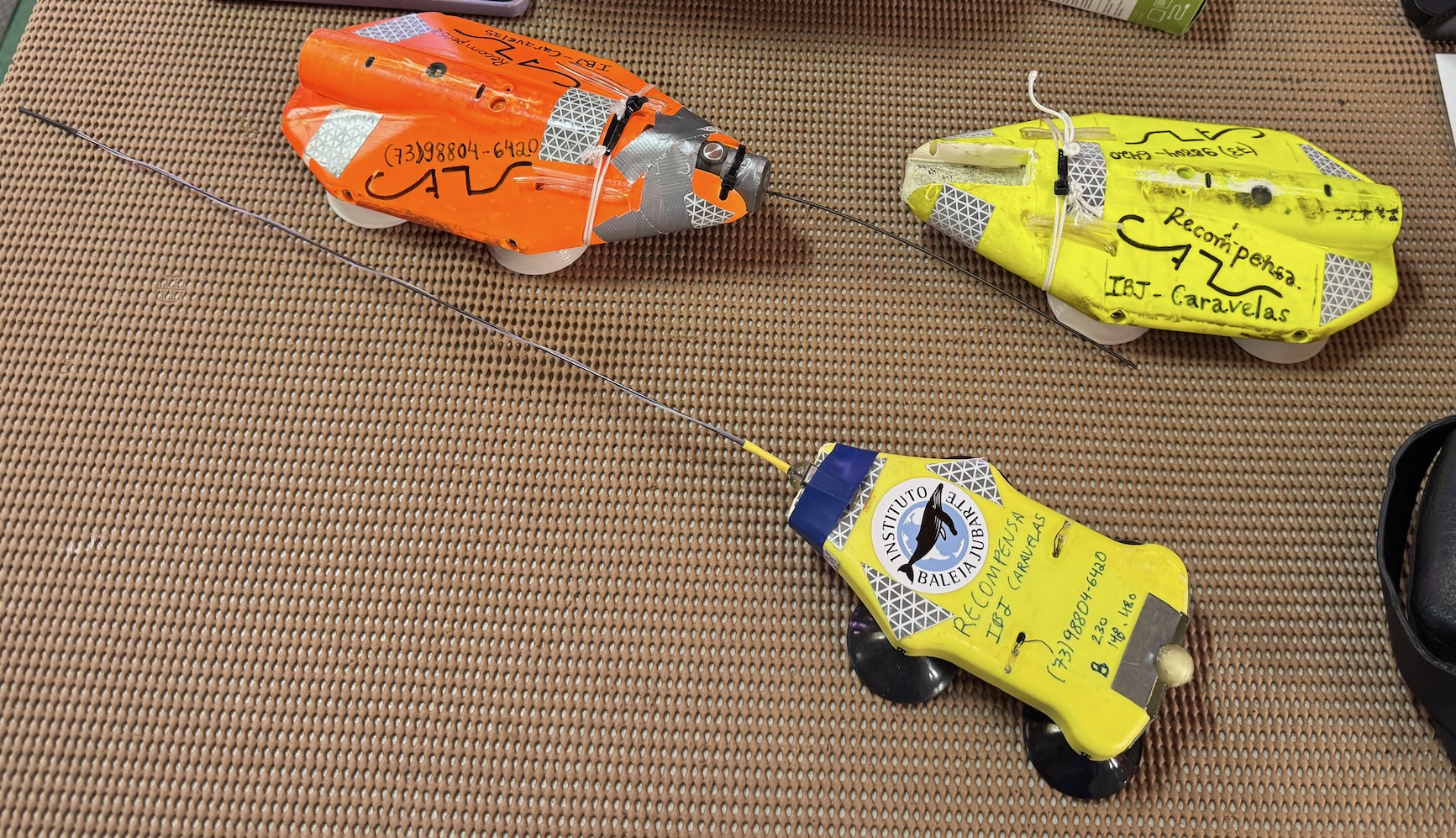
Suction-cup whale tags allow researchers to collect detailed biological and behavioral data while minimizing disturbance to the animals themselves. These tags attach temporarily to the skin of a whale using suction cups, remain in place for a period of time, and then release naturally.
At FaunaLabs, non-invasive tagging is more than a technique — it is a foundational principle guiding how we design whale tagging technology.
The challenge of studying whales in the ocean
Whales live in an environment that is extraordinarily difficult for scientists to observe directly. They spend most of their time underwater, often far from shore, and their movements and behaviors can span enormous spatial scales.
Historically, researchers relied on visual observations from ships or shore. While these observations remain important, they provide only a partial view of whale behavior. Much of what whales do — how they move underwater, how they interact with sound, how their bodies respond to their environment — cannot be seen from the surface.
Whale tags provide a way to measure these hidden aspects of whale biology. By attaching a small sensor package to the body of a whale, researchers can record data streams that reveal how the animal is moving, diving, and responding to its surroundings.
This approach is known as marine mammal bio-logging.
What is marine mammal bio-logging?
Bio-logging refers to the use of miniature electronic tags that record biological and environmental data directly from animals.
In whales and dolphins, bio-logging tags commonly record:
- Movement and orientation using inertial sensors
- Sound using hydrophones
- Depth and temperature to capture environmental context
- Additional physiological or environmental signals depending on the tag design
By combining these measurements, researchers can reconstruct detailed behavioral sequences and environmental interactions.
Why non-invasive tags matter
Some tagging approaches require attaching tags using anchors or darts that penetrate the skin of the animal. While these methods can enable long-duration tracking, they are also invasive.
In contrast, suction-cup whale tags attach temporarily to the surface of the animal without penetrating tissue. The tag stays attached through suction and hydrodynamic pressure while the whale swims. Eventually the tag releases and floats to the surface where researchers can retrieve it.
This approach offers several advantages:
- Minimal physical impact on the animal
- Temporary attachment, avoiding long-term foreign objects on the body
- High-resolution data collection over shorter time periods
- Retrievable tags, allowing large volumes of recorded data to be recovered
Whale tagging technology continues to evolve
Early suction-cup tags used simpler sensors and recorded smaller amounts of data. Today, advances in electronics, batteries, and sensors have enabled a new generation of whale tagging technology.
Modern whale tags may include:
- Inertial measurement units (IMUs) that capture high-resolution movement
- Hydrophones that record the acoustic environment
- Depth and environmental sensors
- Advanced sensing approaches adapted from biomedical technologies
These advances allow researchers to link multiple types of information together: movement alongside sound recordings, environmental context, and physiology-related signals.
A non-invasive approach at FaunaLabs
At FaunaLabs, we design tagging systems around a core idea: marine mammal research should remain non-invasive whenever possible.
Our platform, FaunaTag, is built as a suction-cup attached marine mammal bio-logging tag designed to capture multiple synchronized data streams from whales and dolphins.
FaunaTag integrates sensors for movement, acoustics, depth/temperature, and emerging bio-optical measurements. By combining these signals, the system helps us better understand how whales interact with their environment and how their health and behavior may change in response to natural and human influences.
Understanding whales while protecting them
The ultimate goal of whale tagging is not simply to collect data — it is to deepen our understanding of these animals in ways that support conservation.
Whales face a growing range of environmental pressures, from climate change to underwater noise to changes in prey availability. Understanding how individual whales respond to these pressures is critical for protecting populations over the long term.
Non-invasive whale tagging technology provides one of the most powerful tools available for gathering this knowledge.
By continuing to improve tagging systems while maintaining strong ethical standards, researchers and conservation technologists can help ensure that the science used to protect whales is as responsible as it is informative.